4.3 inch 800x480 TFT LCD GH7006 Driver Chip RGB Interface Display Now Available!
 English
 简体中文
简体中文
 日本語
日本語 Deutsch
 한국어
한국어 Русский язык
 Español
 Français










TFT-H043A34SVIGH6N40-V2-0 | 4.3 inch 800x480 TFT LCD GH7006 Driver Chip RGB Interface Display
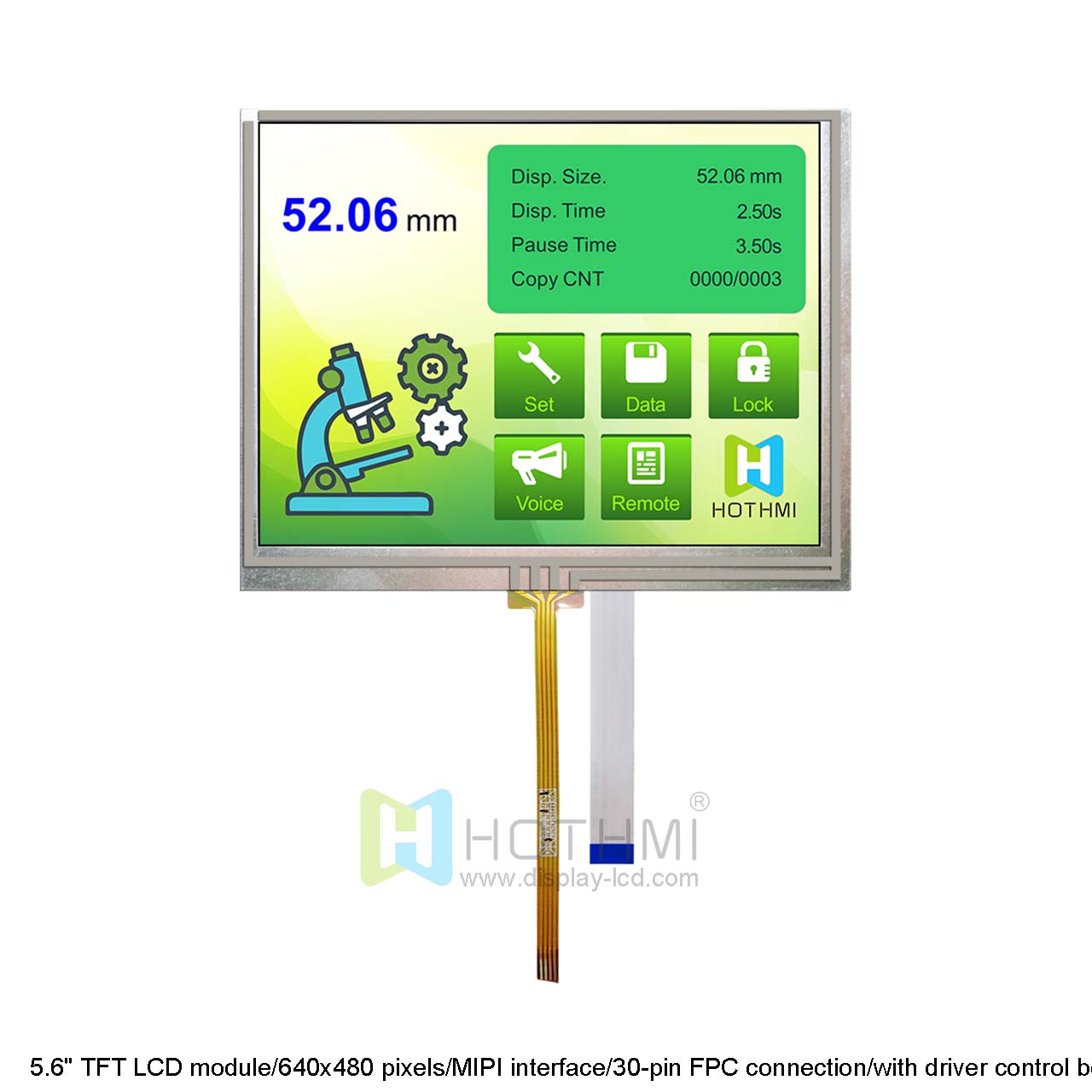
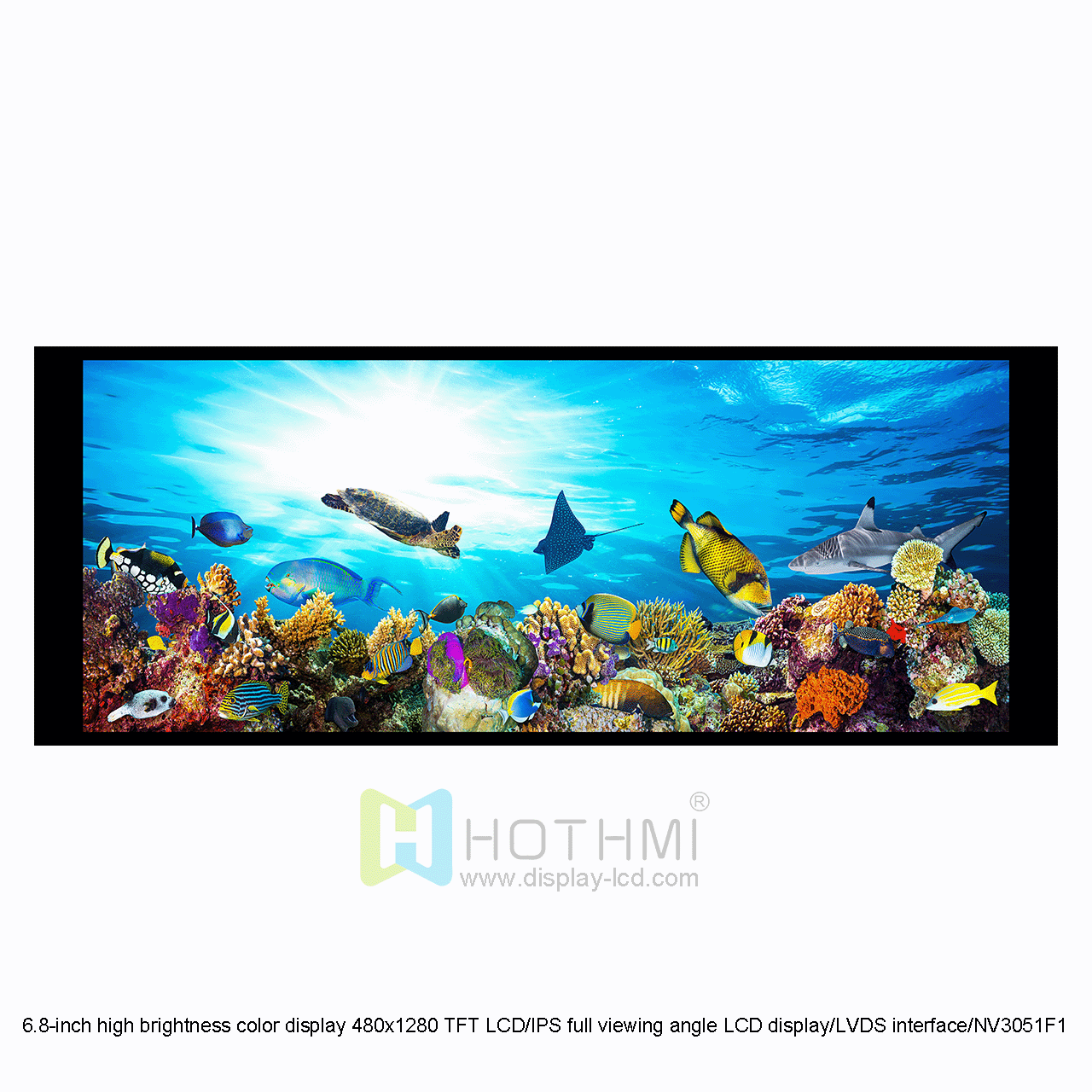
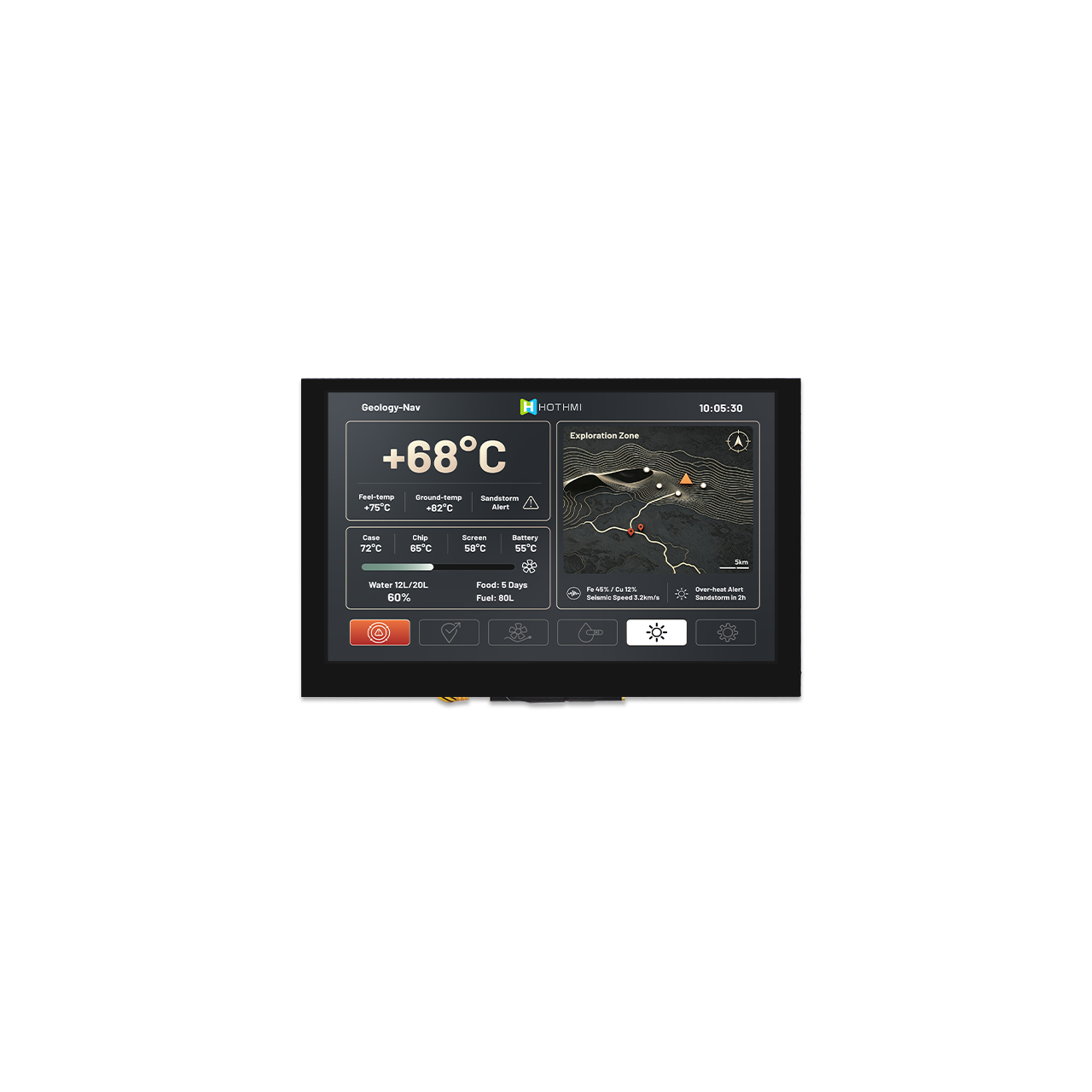
This 4.3 inch 800x480 TFT LCD is a WVGA display module engineered for industrial control applications where reliability and visibility matter. Driven by the GH7006 driver chip over an RGB interface, it delivers stable, flicker-free image output with a 40-pin FPC connection that simplifies integration into existing control boards. As a compact yet high-performance 800x480 TFT LCD, it balances resolution, brightness and ruggedness for HMI panels, instrumentation and embedded systems.
The 800x480 TFT LCD offers a full 80/80/80/80 viewing angle (U80/D80/R80/L80), ensuring consistent color and contrast whether the screen is viewed head-on or from the side — critical for equipment operated from varying positions. With 650cd/m² brightness, this 800x480 TFT LCD remains readable under bright factory lighting and is suitable for semi-outdoor enclosures. The RGB interface supports straightforward timing configuration, and the GH7006 driver provides proven compatibility with common embedded platforms.
Built for demanding environments, this 800x480 TFT LCD carries 8kV ESD protection, safeguarding the panel against electrostatic discharge during handling and operation. It operates across a wide -30 to 85°C temperature range, making the 800x480 TFT LCD suitable for cold-storage equipment, outdoor cabinets and heat-generating machinery. A 3.3V supply voltage keeps power design simple and compatible with mainstream MCUs and SoCs.
Typical uses include industrial control panels, measurement instruments, medical devices and automation terminals. The 4.3 inch form factor with 40-pin FPC allows drop-in replacement in space-constrained designs, while the GH7006 + RGB combination shortens development cycles for teams already familiar with this driver family.
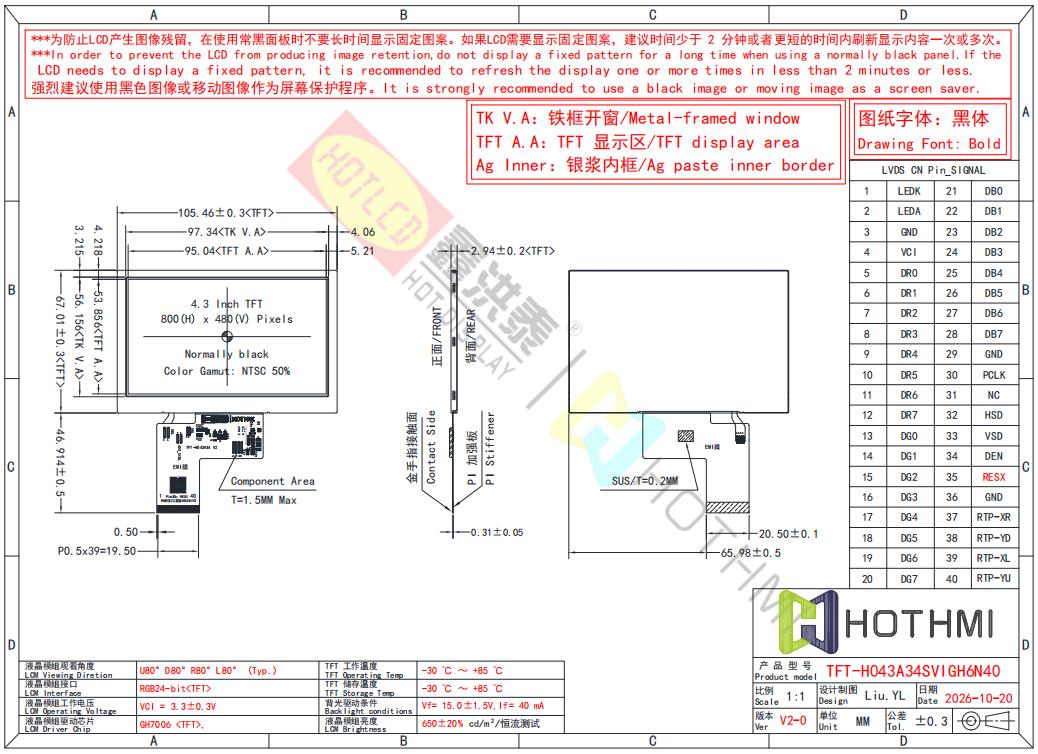
The Specification of the 4.3 inch 800x480 TFT LCD
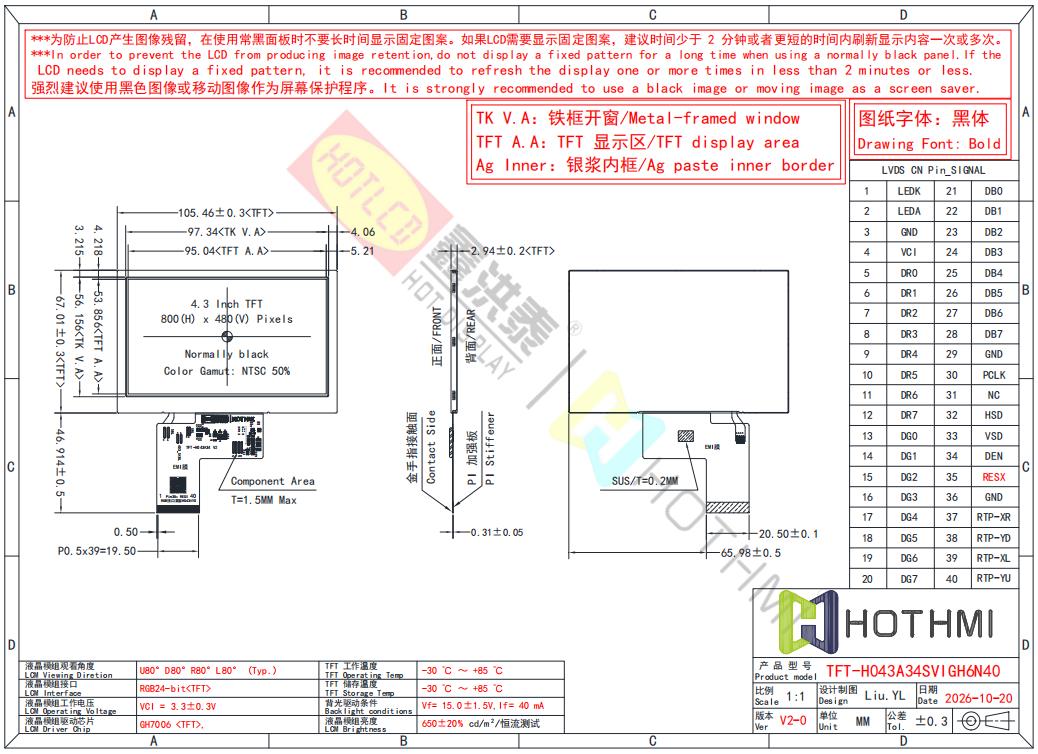
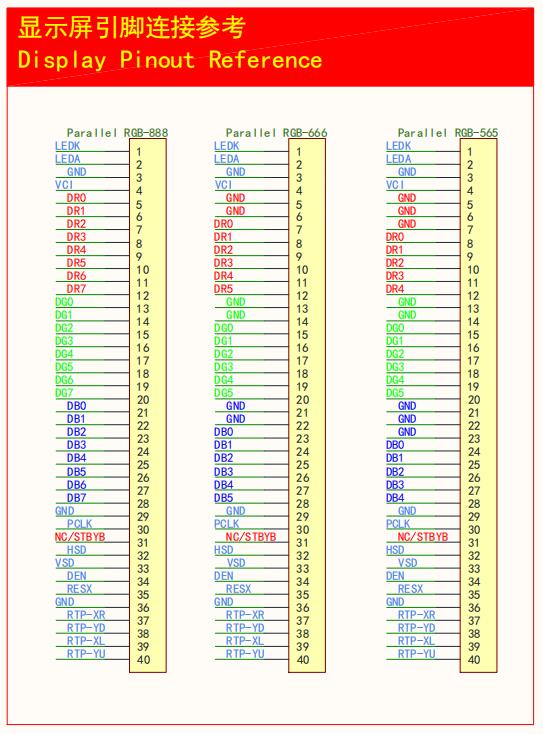
Pinout for this 4.3-inch 800x480 TFT LCD
Pin NO. | Symbol | Description |
1 | LEDK | LED cathode |
2 | LEDA | LED anode |
3 | GND | Power supply ground |
4 | VCI | Power supply |
5~12 | DR0~7 | Red data bus, It is recommended to connect to GND if not in use. |
13~20 | DG0~7 | Green data bus, It is recommended to connect to GND if not in use. |
21~28 | DB0~7 | Blue data bus, It is recommended to connect to GND if not in use. |
29 | GND | Power supply ground |
30 | PCLK | Pixel clock input pin |
31 | NC/STBYB | Not connected. Suggest reserving I/O control when "standby mode" is required |
32 | HSD | Horizontal sync signal. |
33 | VSD | Vertical sync signal. |
34 | DEN | Data input enable. |
35 | RESX | Global reset pin. Active Low to enter Reset State. Built-in RC circuit (10K+0.1uF) |
36 | GND | Power supply ground |
37 | RTP-XR | RTP-XR Position Input |
38 | RTP-YD | RTP-YD Position Input |
39 | RTP-XL | RTP-XL Position Input |
40 | RTP-YU | RTP-YU Position Input |
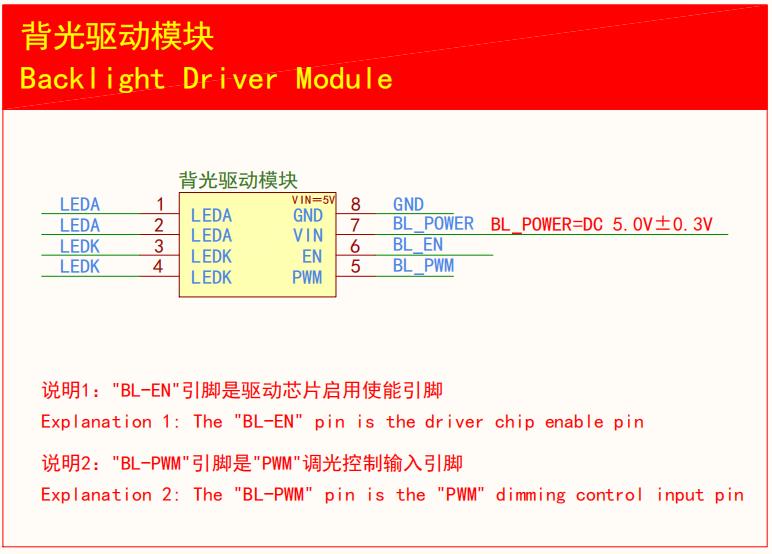
Backlight driving conditions of the 4.3-inch 800x480 TFT LCD
Item | Symbol | Condition | Min | Type | Max | Unit |
Forward voltage | VF | constant | Type | 15.0 | Type | V |
Forward current | IF | - | 40 | - | mA | |
Luminance(With LCD) | Lv | Without TP | Type | 650 | Type | cd/m² |
Have CTP | 550 | |||||
Have CG | 600 | |||||
LED life time | Hr | Ta=25±3 ℃ | 20,000 | 30,000 | - | Hour |