 2.0-inch Smart TFT LCD Display Module 320x240 UART interface Now Available!
 English
 简体中文
简体中文
 日本語
日本語 Deutsch
 한국어
한국어 Русский язык
 Español
 Français




ESP32-P4 Development Board
 2026-09-10
 89
89


2026-09-10
89
During the development of smart display terminals, industrial control equipment, human-machine interaction systems, and smart vision products, engineers often face a practical challenge: even after selecting a screen, they must still design a main control board, backlight circuitry, touch interfaces, and adapter circuits just to perform initial display testing. This lengthy hardware preparation process drives up the cost of early-stage validation.
To address this need, HOTDISPLAY has launched the ESP32P4-DEMO-A02 development board.
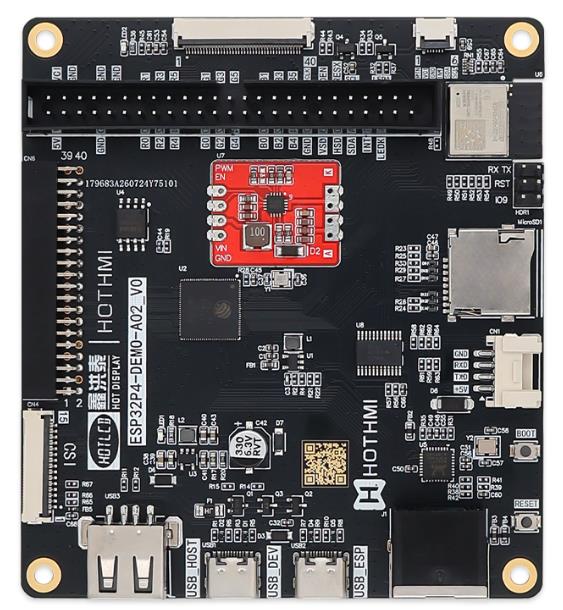
The ESP32P4-DEMO-A02 is an ESP32-P4 development platform designed for applications such as smart displays, human-machine interaction (HMI), industrial control, and smart vision.
Tailored for TFT LCD applications, the development board integrates a standard 40-pin RGB LCD interface, a MIPI DSI display interface, a backlight driver, and capacitive touch signal support. It facilitates preliminary testing and prototyping with TFT LCD screens featuring various specifications and interface types (RGB or MIPI).
For displays with non-standard interface pinouts or FPC configurations, dedicated adapter boards can be used to establish connections, thereby enhancing the platform's compatibility with screens of diverse sizes, resolutions, and interface definitions.
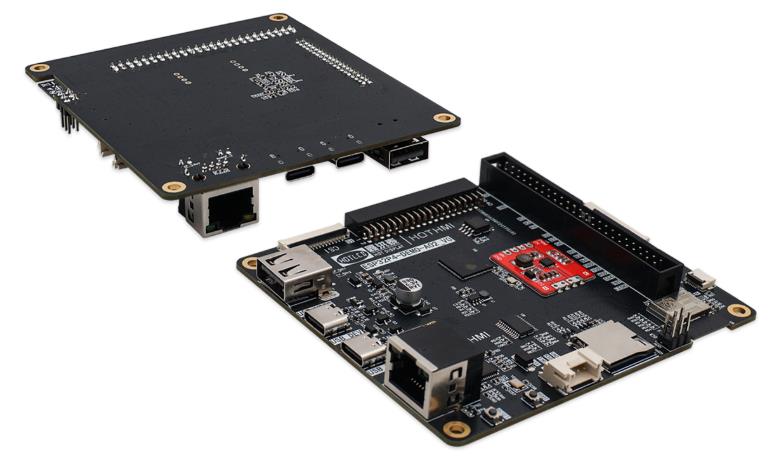
Interfaces and FPC pin assignments can vary significantly across different TFT LCD screens. The ESP32P4-DEMO-A02 supports both RGB LCD and MIPI DSI display interfaces, accommodating a wider range of TFT display solutions.
RGB LCD Interface
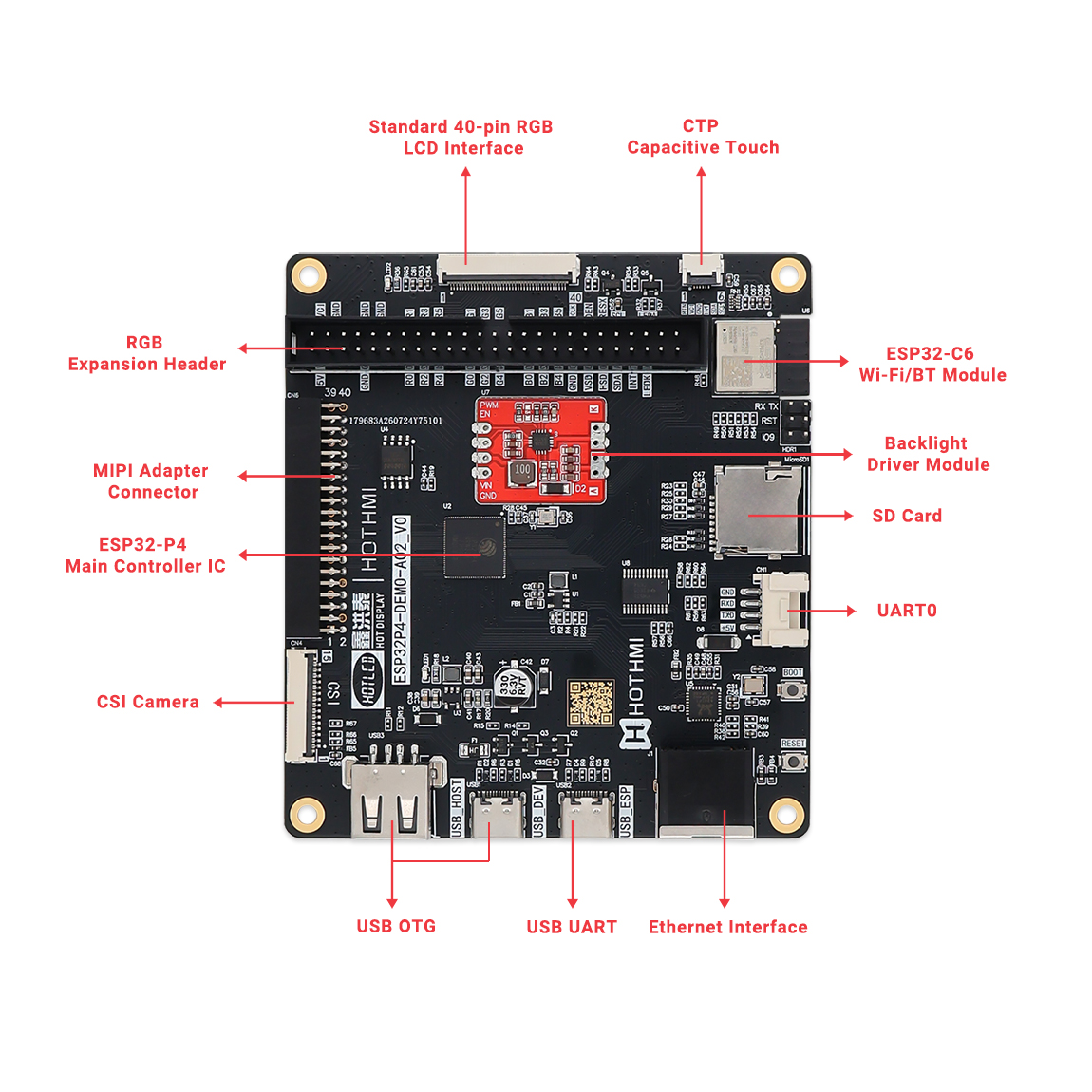
The board features a standard 40-pin RGB LCD connector that routes out RGB data signals, pixel clock, horizontal and vertical synchronization signals, data enable, reset, backlight control, and touch-related signals. RGB signals are also routed to a pin header for convenient signal measurement, debugging, and expansion. For RGB displays with different pinout configurations, custom adapter boards can be designed based on the display's FPC pinout to facilitate quick connection.
MIPI DSI Display Interface
A MIPI DSI display interface is provided for high-resolution display solutions or those utilizing high-speed serial transmission, enabling connection to compatible MIPI-interface TFT LCDs. By using a dedicated MIPI adapter board, customers can test MIPI displays of various specifications on the same ESP32-P4 development platform, thereby simplifying the processes of component selection and verification.
The ESP32P4-DEMO-A02 integrates a dedicated backlight driver module and supports PWM-based backlight adjustment. It enables screen backlight activation and brightness tuning without the need for additional boost or control circuitry.
It features a reserved capacitive touch interface—providing I²C communication, interrupt, and reset signals—to facilitate touch functionality development when used with TFT LCD modules equipped with capacitive touchscreens.
The ESP32P4-DEMO-A02 is powered by the ESP32-P4 high-performance SoC, which features a 32-bit dual-core RISC-V processor with a maximum clock speed of 400 MHz, alongside a low-power RISC-V processor running at up to 40 MHz. The chip supports single-precision floating-point operations as well as AI and DSP instruction extensions, delivering ample computing power for complex graphical user interfaces (GUIs), touch interactions, image processing, and multitasking.
The ESP32-P4 integrates 768 KB of high-performance on-chip memory and supports external PSRAM expansion, providing space for LVGL interface resources, image assets, and display buffer data. It also incorporates a PPA (Pixel Processing Accelerator) and 2D-DMA to assist with image scaling, rotation, color space conversion, and 2D image data transfer; this offloads graphics processing and screen refreshing tasks from the CPU, thereby enhancing interface performance.
To support smart vision and multimedia applications, the ESP32-P4 integrates a MIPI CSI camera interface, an ISP (Image Signal Processor), and H.264 hardware encoding capabilities, providing the necessary hardware support for camera image capture, real-time video preview, and the development of smart vision terminals.
Leveraging these capabilities, developers can use the ESP32P4-DEMO-A02 platform to develop and validate features for LVGL GUIs, industrial HMIs, smart control panels, instrumentation, medical device interfaces, and smart vision terminals.
While the ESP32-P4 itself does not include built-in wireless connectivity, the development board extends Wi-Fi and Bluetooth capabilities via an onboard ESP32-C6 module, enabling the development of features such as wireless network provisioning, data transmission, and remote control.
In addition to display capabilities, the ESP32P4-DEMO-A02 features an onboard MIPI CSI-2 camera interface for connecting compatible camera modules. Customers can perform camera image capture, real-time display previews, and vision-related application development on a single platform.
It is suitable for applications such as barcode and QR code scanners, image capture terminals, industrial vision inspection equipment, video access control systems, smart control panels, and HMI terminals with camera functionality; integrating both display and camera interfaces onto a single development board reduces the complexity of multi-board connections and system debugging.
Extensive USB, storage, and communication interfaces
USB Host – Connects USB peripherals such as keyboards, mice, and storage devices.
USB Device – Enables data communication with a computer or host system.
USB-to-Serial Debugging – Supports program downloading, log viewing, and serial debugging.
MicroSD Card – Stores images, fonts, UI resources, configuration files, and operational data.
10/100M Ethernet – Facilitates network communication, data uploading, and remote device management.
UART and I²C – Connects sensors, controllers, touch chips, and other external modules.
| Parameter | Details |
|---|---|
| Product Model | ESP32P4-DEMO-A02 |
| Main Control Platform | ESP32-P4 |
| Wireless Communication | Onboard ESP32-C6 Wi-Fi/Bluetooth Module |
| Display Interface | RGB LCD, MIPI DSI |
| Camera Interface | MIPI CSI-2 |
| Touch Interface | Capacitive Touch I²C Interface |
| Network Interface | 10/100M Ethernet |
| Storage Expansion | MicroSD Card |
| USB Interface | USB Host, USB Device, USB to Serial |
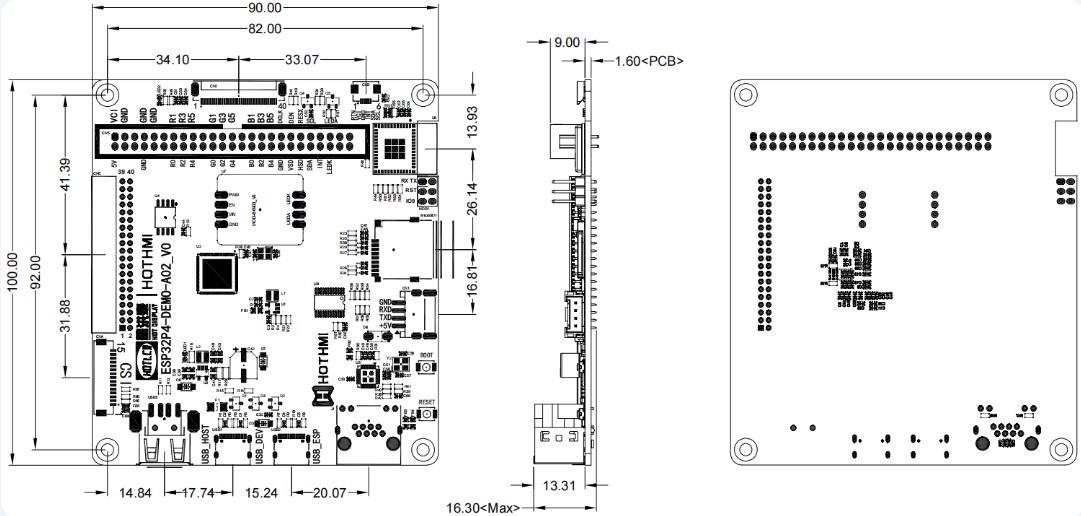
| PCB Dimensions | 100.00mm × 90.00mm |
| PCB Thickness | 1.60mm |
| Maximum Height | 16.30mm |
| Mounting Method | Four Corner Mounting Holes |
The ESP32-P4-DEMO-A02 is far more than a simple demo board designed merely to showcase LCD display capabilities. Leveraging the ESP32-P4's processing power, extensive display and communication interfaces, and onboard wireless/wired networking and storage resources, customers can build functional prototypes that closely resemble actual products directly on the development board.
1. Smart Display Terminals & HMIs
Development and validation involving touch-enabled HMIs, smart control panels, equipment operation interfaces, and LVGL-based graphical interfaces.
2. Industrial Control Equipment
Industrial control panels, equipment status monitoring, parameter configuration, data acquisition, and on-site information display.
3. Smart Vision Terminals
Barcode scanning devices, image acquisition, visual inspection, and real-time camera preview.
4. IoT and Network Terminals
Support for Wi-Fi, Bluetooth, and Ethernet; applications include industrial gateways, connected controllers, and data acquisition terminals.
5. Embedded Product Prototyping
ESP32-P4 functional evaluation, system development, display solution selection, and feasibility validation.
One of the primary functions of the ESP32P4-DEMO-A02 is to facilitate the testing and bring-up of RGB and MIPI interface TFT LCDs supplied by HOTDISPLAY. During the project selection phase, customers can choose the appropriate connection method or dedicated adapter board based on the screen's interface, resolution, size, and FPC pinout. The development board enables a wide range of tasks, including TFT display function testing, screen initialization code debugging, verification of display timing and interface parameters, capacitive touch debugging, backlight brightness and PWM control testing, LVGL graphical interface validation, camera capture and display testing, USB/MicroSD/network functionality testing, and functional prototyping of the complete system. This allows customers to verify whether the display and system solution meet product requirements before committing to the design of a dedicated mainboard, thereby reducing early-stage development risks.
While standard development boards are suitable for initial testing and prototype validation, customers often need to redesign the control board—based on the device's overall mechanical structure, interface requirements, and target costs—once the product project is officially launched.
HOTDISPLAY offers custom PCB services tailored to specific project requirements, including: customizing PCB form factors, mounting dimensions, and mounting hole locations; matching FPC interfaces for specific TFT LCDs; integrating display, touch, and backlight driver circuitry; adding or removing USB, UART, I²C, and network interfaces; adjusting wireless communication and storage capabilities; optimizing power management; redesigning component layouts to fit the device structure; removing development-only interfaces unnecessary for mass production while adding required peripheral functions; and ensuring full system integration across the display, touch panel, and control board.
Customers can initially use the ESP32P4-DEMO-A02 to validate software and product functionality, then integrate these verified features into a custom PCB once the project officially moves forward. This development workflow—transitioning from standard development board validation to custom PCB mass production—helps minimize redesigns, shorten product development cycles, and reduce integration risks.
For the ESP32P4-DEMO-A02 development board and its associated display screen project, HOTDISPLAY provides comprehensive development and hardware reference materials. These include mechanical dimension drawings, schematics, pin definitions, display specifications, connection references, adapter board design support, recommendations for display drivers and interface adaptation, and support for custom product development.
If customers have already determined the display size, resolution, and interface type, they can submit their specific product requirements to us; our engineering team will then assist in evaluating the development board, display screen, and adapter solutions.
From development verification to product customization: The ESP32P4-DEMO-A02 integrates features such as RGB LCD, MIPI DSI, MIPI CSI-2, capacitive touch, backlight driving, MicroSD, USB, UART, I²C, Ethernet, and wireless communication. It enables engineers to rapidly complete tasks such as bringing up the TFT LCD, debugging touch functionality, developing LVGL graphical interfaces, and verifying overall system functionality.
Once customers have validated the display solution and product functions, HOTDISPLAY offers customization services—tailored to the device's mechanical structure, interface configuration, and mass-production cost requirements—covering PCB dimensions, interfaces, power supply, and specific functions. This facilitates a smooth transition from prototype verification to the productization stage.
To test the ESP32P4-DEMO-A02 development board, source compatible RGB or MIPI TFT LCDs, or inquire about custom control board solutions, please contact HOTDISPLAY for product documentation and technical support.



China Custom Industrial TFT LCD Display Manufacturer & Global LCD Supplier
Address:Building N3, Tian'an Digital Industry Park, Fenggang Town, Dongguan City, Guangdong Province, China