 4.3 inch 800x480 TFT LCD GH7006 Driver Chip RGB Interface Display Now Available!
 English
 简体中文
简体中文
 日本語
日本語 Deutsch
 한국어
한국어 Русский язык
 Español
 Français




What is Ultra Wide temperature TFT LCD Display?
 28 Jan 2026
 2559
2559


28 Jan 2026
2559
Ultra-wide temperature display is specially designed display devices that can operate stably in extremely high and low temperature environments. Ultra Wide temperature TFT LCD Display is typically used in demanding environments such as industrial, military, outdoor, and aerospace applications. Standard displays typically operate between 0°C and 50°C, while ultra-wide temperature range displays can withstand extreme temperatures from -20°C to +70°C or even wider range from -40°C to +90°C .
HOTHMI offers Ultra Wide temperature TFT LCD Display, ranging in size from 0.85 inches to 32 inches. They also provide various interfaces, customized capacitive touch panels, resistive touch panels, and development solutions for these ultra wide temperature displays.
Feature | Standard Display | Ultra Wide temperature TFT LCD Display |
Temperature Range | 0°C to 50°C | -20°C to +70°C (even wider range from -40°C to +90°C) |
Cost | Low | Higher (due to specialized materials and processes) |
Lifetime | Suitable for standard environments | Optimized for harsh conditions, often longer lifespan |
Typical Applications | Consumer electronics, indoor equipment | Industrial, military, outdoor, and harsh environments |
As we can see from the table, Ultra Wide temperature TFT LCD Display is specifically designed for extreme temperature environments. Through a triple optimization of materials, circuitry, and structure, they ensure clear and stable information display even under extreme cold, heat, or drastic temperature fluctuations. Although the cost is higher, the reliability and adaptability of ultra wide temperature tft lcd displays are irreplaceable for certain industries.
l Low-temperature issues: Using heating films or temperature control devices on the TFT LCD to prevent liquid crystal freezing; using low-viscosity liquid crystals to improve response speed.
l High-temperature issues: High-efficiency heat dissipation design (such as metal casing, heat sinks); using high-temperature resistant optical materials (such as polarizers, adhesives).
l Temperature difference variations: Structural design to resist thermal expansion; reinforced component soldering to prevent desoldering due to thermal expansion and contraction.
l Power consumption and reliability: Optimizing circuit energy efficiency; rigorous testing (such as high and low-temperature cycling tests, vibration tests).
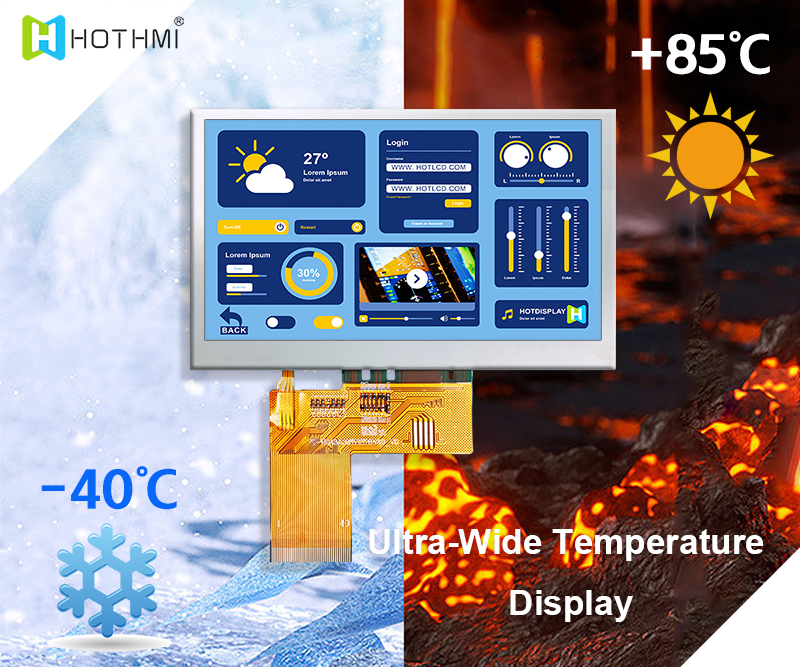
If the device needs to be used in the following environments, an ultra wide temperature TFT LCD display should be considered:
l Cold regions: Outdoor temperatures below -20°C in winter.
l High-temperature environments: The surface temperature of the device may exceed 60°C under direct sunlight in summer.
l Sudden temperature changes: Such as condensation occurring when a vehicle-mounted device moves from a cold outdoor environment into a warm garage.
Answer:Yes, but after optimization, the impact is within an acceptable range. All LCD screens experience slower response times at low temperatures. True ultra wide temperature display, through the aforementioned technologies, can control the response time at low temperatures (such as -30°C) to within 2-3 times that of standard temperatures, while ordinary screens may cease to function properly or exhibit extremely severe ghosting.
ultra wide temperature tft lcd display typically have two brightness characteristics:
1. High brightness option: To cope with strong outdoor light, they are often equipped with high-brightness backlights of 1000 nits or even higher.
2. Wide temperature brightness compensation: A built-in temperature sensor automatically increases the driving current at low temperatures to compensate for brightness degradation, and appropriately reduces it at high temperatures to protect the LEDs and prevent overheating.



China Custom Industrial TFT LCD Display Manufacturer & Global LCD Supplier
Address:Building N3, Tian'an Digital Industry Park, Fenggang Town, Dongguan City, Guangdong Province, China