 4.3 inch 800x480 TFT LCD GH7006 Driver Chip RGB Interface Display Now Available!

 English
 简体中文
 日本語
 Deutsch
 한국어
 Русский язык
 Español
 Français





4.0-inch TFT LCD Display For 1U Computer case
 27 Oct 2026
 7


27 Oct 2026
7
During the development of industrial control, communication equipment, smart instruments, and embedded terminals, the selection of display modules not only affects display performance but also influences main control interface adaptation, device space layout, and overall environmental adaptability. This is especially true in height-constrained devices such as 1U Computer case LCD enclosures, where configuring the display area within limited panel space while balancing interface options, brightness, and operating temperature requirements is an important consideration in product design.
In response to these application requirements, HOTDISPLAY has introduced the TFT-H040A31WQINVKN22 4.0-inch TFT liquid crystal display module. This product features an elongated display structure, with a module outline height of only 38.9 mm, making it suitable for evaluation in compact panel layouts for 1U Computer case LCD systems; it also supports SPI, QSPI, and 8-bit MCU interface options, with a nominal brightness of 1100 cd/m² and an operating temperature range of −30°C to +85°C.
Through its compact structural design, multiple interface options, relatively high backlight brightness, and wide-temperature operating capability, this product provides a multifaceted selection reference for industrial control, communication equipment, instrument terminals, and other embedded display applications, including 1U Computer case LCD applications.
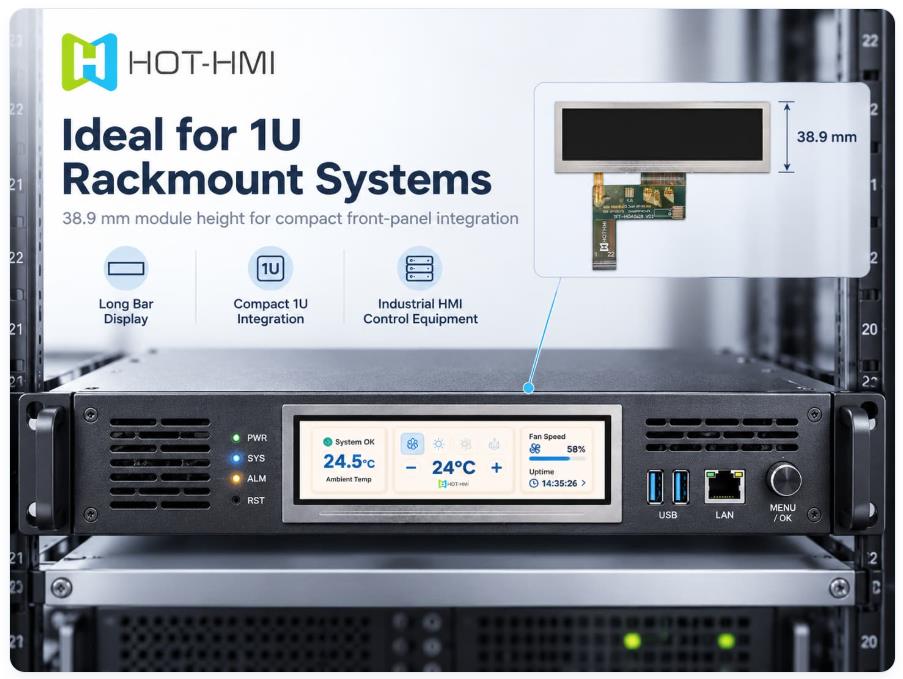
In communication equipment, industrial control equipment, and rack-mounted electronic devices, chassis height is often strictly limited. Especially for 1U Computer case LCD, display panels, control buttons, indicator lights, connectors, and internal electronic components need to be arranged within limited vertical space. The overall height of the display module has therefore become an important factor affecting panel layout.
The TFT-H040A31WQINVKN22 adopts a 4.0-inch elongated display structure, with module dimensions of 105.50 mm × 38.90 mm × 2.85 mm (width × height × thickness). Among these, the 38.9 mm module height provides a spatial advantage for compact panel design, making it particularly suitable for evaluating the display layout of 1U Computer case LCD and other low-height equipment.
The height of a standard 1U rack unit is 44.45 mm. Using this as a reference, the 38.9 mm-high display module has a good matching basis in terms of height dimensions, helping engineers plan the display area within limited vertical space and leaving certain layout space for panel structure design.
✅The elongated aspect ratio allows for more efficient use of limited space.
This product features a resolution of 480 (H) × 128 (V) pixels, with an active display area of 95.04 mm × 25.34 mm. The horizontally elongated display area is well-suited for presenting multiple sets of information side-by-side, such as device operating status, numerical readings, working modes, alarm notifications, and key parameters.
For rack-mounted equipment and compact control terminals, this aspect ratio can be used to create a horizontal information interface, allowing essential data to be presented centrally without consuming excessive vertical space. Depending on the functional requirements of the equipment, developers can integrate status icons, numerical readings, and concise operational prompts within the same display area.
Furthermore, the 2.85 mm module thickness serves as a reference for planning the device's internal structure. Engineers can coordinate the placement of internal components and the display area by taking into account the positioning of the front panel, motherboard, connectors, and ribbon cables.
✅Structural adaptation for 1U chassis and compact equipment
With a module height of 38.9 mm, the TFT-H040A31WQINVKN22 is a suitable candidate for display panels integrated into 1U chassis—particularly for equipment that requires horizontal information display while operating under constraints on vertical mounting space.
Please note that the module’s external dimensions do not equate to the final panel cutout dimensions. Actual installation must account for factors such as panel thickness, mounting methods, bezel coverage, space for ribbon cable routing (including bend radii), and assembly tolerances. Therefore, it is recommended to verify dimensions and installation feasibility against the chassis structural drawings during the project design phase.
In embedded display systems, the interface not only determines the communication method between the display module and the main control chip, but also affects GPIO resource allocation, PCB routing, data transmission efficiency, and software driver development. Different devices employ different main control platforms and hardware architectures; therefore, whether a display module can provide interface options suitable for different projects is an important factor affecting system integration. For a 1U Computer case LCD, interface flexibility is equally relevant when selecting an embedded display solution.
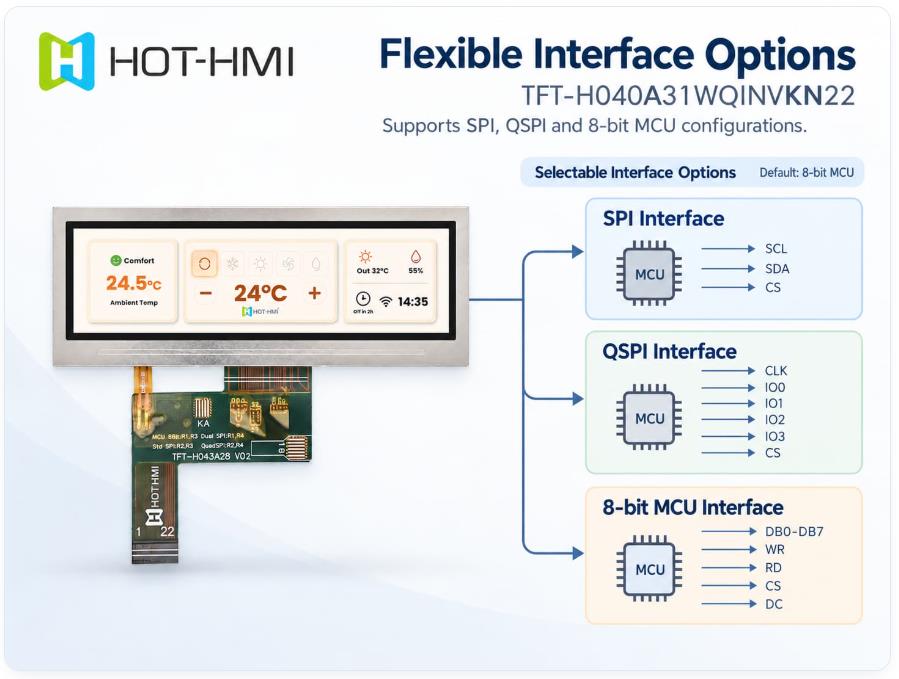
TFT-H040A31WQINVKN22 supports three optional interface schemes: SPI, QSPI, and 8-bit MCU, with the default interface being 8-bit MCU. This interface configuration provides multiple design paths for different embedded systems, allowing engineers to evaluate a suitable connection method based on the interface resources of the main control chip, display content complexity, update frequency, and software architecture. In applications involving a 1U Computer case LCD, these interface options can also help balance hardware resources and development requirements.
● SPI interface: Suitable for serial communication architectures
SPI is a common serial communication interface in embedded systems and is widely used for data exchange between microcontrollers and peripheral devices. For display projects that need to make reasonable use of the main control pin resources and control the complexity of hardware connections, SPI can serve as an interface option.
In practical applications, SPI can be used to transmit display data such as digital readings, status icons, operating parameters, and prompt messages. Engineers can evaluate whether SPI meets the update requirements of a target interface by considering factors such as the capabilities of the host controller’s SPI interface, the communication clock frequency, the display data format, and the software drivers.
For embedded terminals primarily focused on device status, parameter readout, and basic human-machine interaction, SPI offers a common serial display interface solution.
● QSPI Interface: Providing More Options for Display Data Transmission
As the interface content of embedded devices gradually becomes richer, the transmission efficiency of display data has also become a factor to consider when selecting interfaces.
QSPI uses multiple data lines to transmit information. Compared with traditional single-data-line SPI, it can provide higher data transmission efficiency under compatible hardware and appropriate clock configurations. Therefore, for projects that need to evaluate higher display data throughput capability while hoping to adopt a serial interface architecture, QSPI can provide another design option.
In applications involving a large amount of display data, complex interfaces, or relatively frequent screen updates, engineers can evaluate QSPI solutions according to actual requirements. However, the specific transmission rate and screen update performance still depend on the host controller capability, interface configuration, communication clock, and software driver, and the final performance cannot be judged directly from the interface name alone.
● 8-bit MCU interface: Adapted for corresponding parallel display architectures
In addition to a serial interface, this product also supports an 8-bit MCU interface, which is designated as the default interface.
For host platforms that utilize a compatible parallel MCU display interface, this solution can be considered for integration into the existing hardware architecture. Engineers can proceed with hardware connections and display debugging based on the module’s pin definitions, control signals, and software drivers.
In scenarios where a host platform has already been selected and there is a preference to retain an existing parallel interface architecture, the 8-bit MCU interface offers an additional option for system integration.
● Multi-interface design adds flexibility to project development.
The value of these three types of interfaces lies not merely in expanding the range of available interface options, but, more importantly, in enabling display modules to be evaluated for compatibility across different hardware architectures.
During the initial phase of project development, engineers can focus on the following factors:
▶ Host Controller Compatibility: Verify whether the host controller chip supports the required SPI, QSPI, or 8-bit MCU interface.
▶ Data Transmission Requirements: Assess the necessary transmission capacity based on interface complexity, refresh rate, and the content to be displayed.
▶ Hardware Resources: Consider factors such as the number of available GPIO pins, PCB routing space, and connection methods.
▶ Software Development: Conduct adaptation and verification by integrating device drivers, initialization code, and the target platform.
⚠️Please note: SPI, QSPI, and 8-bit MCU are optional interface configurations; this does not imply that a single module can support all these interface modes simultaneously without requiring hardware or configuration adjustments. For actual projects, the specific interface version should be confirmed during the component selection phase.
During the selection of display modules, interface compatibility is often an important factor determining whether a solution can be implemented smoothly. By offering multiple interface options, the TFT-H040A31WQINVKN22—well suited for a 1U Computer case LCD integration—can provide a more flexible system integration path for embedded display projects with different host control architectures, helping engineers carry out hardware design and software development according to actual requirements.
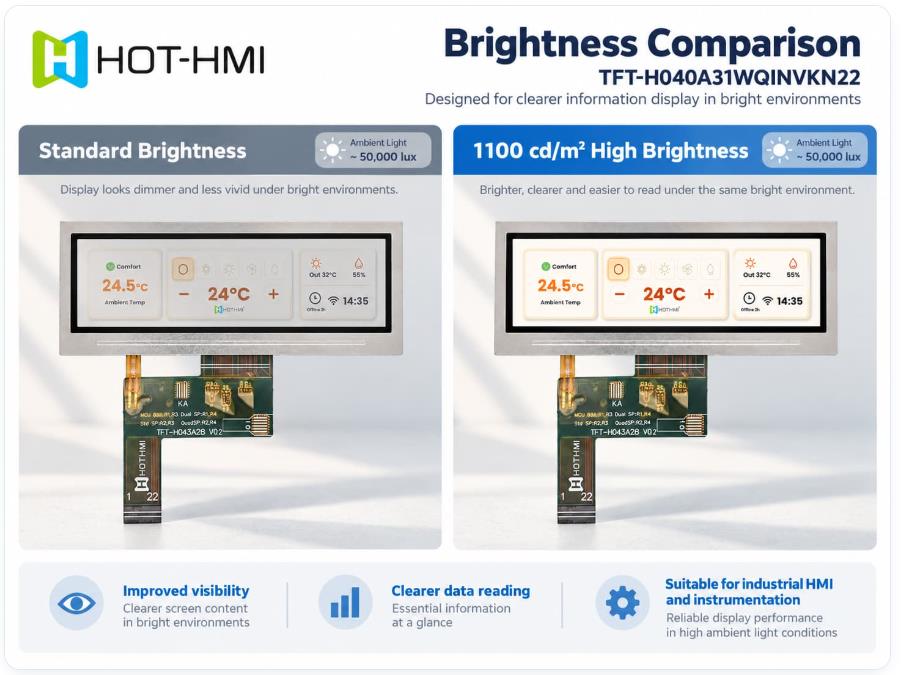
In industrial instruments, outdoor control terminals, and vehicle auxiliary equipment, display screens need to present digital readings, operating parameters, status icons, and operation prompts. As ambient light increases, the visual contrast between the displayed image and the surrounding environment may decrease; therefore, backlight brightness is one of the important parameters when selecting a display module. The 1U Computer case LCD typically requires reliable visibility in such applications.
The TFT-H040A31WQINVKN22 has a typical brightness of 1100 cd/m², corresponding to the module configuration without a touchscreen. Higher backlight brightness can provide sufficient light output and, under reasonable overall optical design, help improve display readability in brighter environments.
✨ The Value of High Brightness in Practical Device Applications
For industrial control panels, displays usually need to continuously present equipment operating status, measurement data, and alarm information. A higher brightness level can provide a good visual foundation for these contents, helping designers plan display solutions according to the equipment's usage environment. In this regard, the 1U Computer case LCD can serve as a useful reference for projects requiring reliable visual presentation.
In smart instruments and vehicle auxiliary equipment, the display area often undertakes the task of presenting critical data and status information. A typical brightness of 1100 cd/m² can provide a reference for evaluating display performance under different lighting conditions, and is especially suitable for inclusion in embedded display projects requiring higher backlight output for selection comparison. The 1U Computer case LCD is well suited to such evaluation scenarios.
For outdoor control terminals, ambient light may change with weather, time, and equipment installation location. Higher backlight brightness can help improve the visual performance of the display image, but the final readability still needs to be comprehensively judged in combination with actual usage conditions. The 1U Computer case LCD can also be considered in this context when assessing overall display suitability.
✨ From brightness parameters to overall display performance
Brightness is not the only factor determining display performance. Screen surface reflection, cover glass transmittance, viewing angle, mounting orientation, and the overall optical structure of the device can all affect the final visual performance.
Therefore, the 1100 cd/m² typical brightness provides a high backlight output baseline for the product, but it cannot alone serve as a guarantee that the display will be clearly readable under direct strong sunlight. For outdoor or high-brightness applications, it is recommended to conduct testing and verification in combination with the overall device structure, cover glass, and actual environment.
For industrial instruments, vehicle auxiliary equipment, and embedded control terminals that prioritize information legibility, the brightness performance of the TFT-H040A31WQINVKN22 provides a clear technical basis for display solution evaluation, and the 1U Computer case LCD form factor makes it well suited to space-constrained installations; in such compact 1U Computer case LCD designs, thermal and optical integration should also be considered during evaluation.
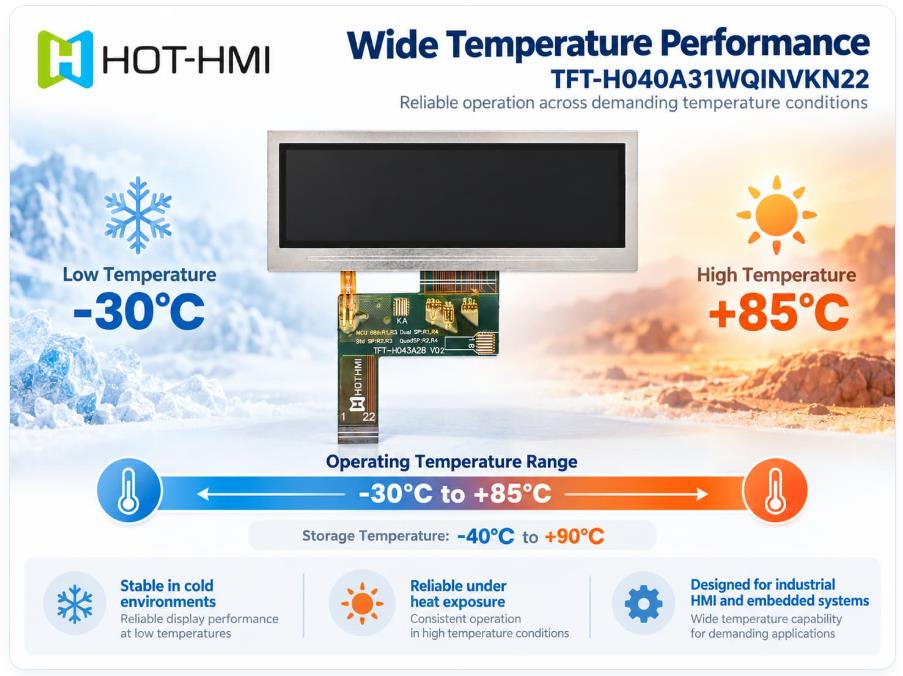
Industrial equipment, vehicle auxiliary terminals, and outdoor electronic devices may face significant ambient temperature variations. Low-temperature environments may occur in cold regions or during winter outdoors, while high-temperature environments may result from summer exposure to direct sunlight, internal heat accumulation within the device, or installation locations near heat-generating components. Therefore, the operating temperature range is a key parameter to consider when selecting an industrial display module, and this is also an important factor in applications involving a 1U Computer case LCD.
The TFT-H040A31WQINVKN22 supports an operating temperature of −30℃ to +85℃ and a storage temperature range of −40℃ to +90℃. This temperature range provides a selection basis for equipment that needs to operate under conditions with large temperature variations, and can be used to evaluate applications such as industrial control, smart instruments, vehicle auxiliary equipment, and outdoor terminals. For projects involving a 1U Computer case LCD, these temperature specifications also serve as a useful reference for assessing environmental adaptability.
In lower-temperature environments, the product's specified lower operating temperature limit of −30℃ helps engineers evaluate the device's adaptability for use under cold conditions; in higher-temperature environments, the upper operating temperature limit of +85℃ provides a reference for the device's thermal design, installation location selection, and temperature rise assessment.
✨ The Significance of Wide-Temperature Design in Applications
For industrial control equipment, the ambient temperature at the production site may vary with the season, the operating state of the equipment, and the installation location. A wide operating temperature range can provide a basis for selecting display solutions for such equipment, and a 1U Computer case LCD with a wide temperature range is particularly suitable for such scenarios.
For vehicle auxiliary instruments and outdoor terminals, the equipment may experience low-temperature startup, long-term operation, or heat accumulation in high-temperature environments. The operating temperature parameters of the display module can help designers make a preliminary judgment on whether it meets project requirements, and further plan the power supply, heat dissipation, and installation solutions of the whole machine. A 1U Computer case LCD can also serve as a reference option in such temperature-sensitive applications.
⚠️ Please note: The operating temperature range of a display module is not equivalent to that of the complete device. Individual components—such as the main control chip, power supply module, backlight driver circuitry, and connectors—must each independently meet the specific requirements of the application. For actual projects, it is essential to conduct verification by accounting for factors such as the device's overall temperature rise, heat distribution, mounting structure, and operational duty cycle, ensuring that the entire system satisfies the operating conditions required for the target equipment.
With an operating temperature range of -30°C to +85°C, the TFT-H040A31WQINVKN22 provides a more robust basis for evaluating display solutions for industrial and embedded equipment subject to significant temperature fluctuations.
The TFT-H040A31WQINVKN22 adopts the NV3041A display driver chip. The datasheet provides the corresponding pin definitions, interface reference circuits, and initialization code, which can serve as technical references for engineers carrying out hardware connection, driver adaptation, and display debugging. For engineers working with a 1U Computer case LCD, these resources can also offer useful reference value for display integration.
In terms of optical performance, the product has a typical contrast ratio of 1200:1, typical four-direction viewing angles of 85° each for up, down, left, and right, a typical color gamut of 50% NTSC, and a typical response time of 30 ms.
These parameters can be combined with brightness, resolution, and actual interface requirements to evaluate whether the product meets the display requirements of the target device. For industrial interfaces that mainly present numbers, icons, and operating status, engineers can make comprehensive judgments based on the information presentation method, viewing position, and color requirements. Such parameter-based evaluation is also applicable when selecting a 1U Computer case LCD for industrial applications.
Featuring an elongated form factor, a variety of interface options, a nominal brightness of 1100 cd/m², and an operating temperature range of −30°C to +85°C, the TFT-H040A31WQINVKN22 can be used to evaluate applications in the following areas:
✅1U Chassis and Rack-Mount Equipment: With a module height of 38.9 mm, this component is suitable for integration into the panel layouts of low-profile (1U) chassis, where it can be used to display device status, operational data, and alarm information. Specific installation requirements—including chassis cutouts, mounting structures, and assembly clearances—must be verified.
✅ Industrial Control Equipment: Utilizes an elongated display area to present operational parameters, alarm information, and control data; display solutions are evaluated against the requirements of the production environment, with a focus on wide-temperature operational capabilities.
✅ Smart Instruments and Vehicle Auxiliary Equipment: Employs a landscape-oriented display area to present multiple data sets and operational statuses; the suitability of the display solution is assessed based on actual temperature fluctuations and the specific installation environment.
✅ Outdoor Control Terminals: Leverages a nominal brightness of 1100 cd/m² and a wide-temperature operating range to meet display requirements across varying ambient light levels and environmental temperatures.
✅ Embedded Smart Devices: Incorporates SPI, QSPI, or 8-bit MCU interfaces—selected based on the main control platform—while accounting for hardware resources, display refresh requirements, and software development constraints.
Specific applications still require verification, taking into account the overall system structure, power supply scheme, environmental conditions, and the reliability requirements of the target equipment.
ITEM | PARAMETER DESCRIPTION |
TFT series | TFT-H040A31WQINVKN22 |
Diagonal size | 4.0-inch |
Resolution | 480x128 |
Dimensions | 105.5x38.9x2.85 (mm) |
Active area (AA) | 95.04x25.34 (mm) |
LCD type | 4.0-inch Bar Display |
Display viewing angle | Full View |
Aspect ratio | 3:1 |
Backlight type | LED white |
TFT driver IC | NV3041A<TFT> |
Brightness | 1100cd/m² |
Operating temperature | -30~85℃ |
Storage temperature | -40~90℃ |
For more detailed information regarding the product, please click the product link:TFT-H040A31WQINVKN22
For industrial control, communication equipment, rack-mounted terminals, and other embedded devices, the display module needs to balance structural space, interface compatibility, display performance, and operating environment.
The HOTDISPLAY TFT-H040A31WQINVKN22 provides clear direction for product selection around four key features: a 38.9 mm module height and a long strip display structure offer an option for compact panel layouts in a 1U Computer case LCD; SPI, QSPI, and 8-bit MCU multi-interface solutions provide flexible integration paths for different host control architectures; a nominal brightness of 1100 cd/m² supports information display in brighter environments; and an operating temperature range of −30°C to +85°C provides a basis for application evaluation under conditions of greater temperature variation.
Combined with a 4.0-inch display structure and the NV3041A display driver IC, this product can serve as a candidate solution for industrial displays, rack-mounted equipment, smart instruments, and customized embedded terminals. HOTDISPLAY can assist in evaluating suitable display module configurations based on the customer's host control platform, chassis dimensions, interface requirements, display content, and operating environment, including options for a 1U Computer case LCD.



China Custom Industrial TFT LCD Display Manufacturer & Global LCD Supplier
Address:Building N3, Tian'an Digital Industry Park, Fenggang Town, Dongguan City, Guangdong Province, China