 8-inch 800x600 TFT LCD Display With RGB Interface IPS Panel Now Available!
 English
 简体中文
简体中文
 日本語
日本語 Deutsch
 한국어
한국어 Русский язык
 Español
 Français




What is the difference between the optically bonding and the air bonding?
 2024-05-22
 7951
7951


2024-05-22
7951
Optical Bonding lamination Process:
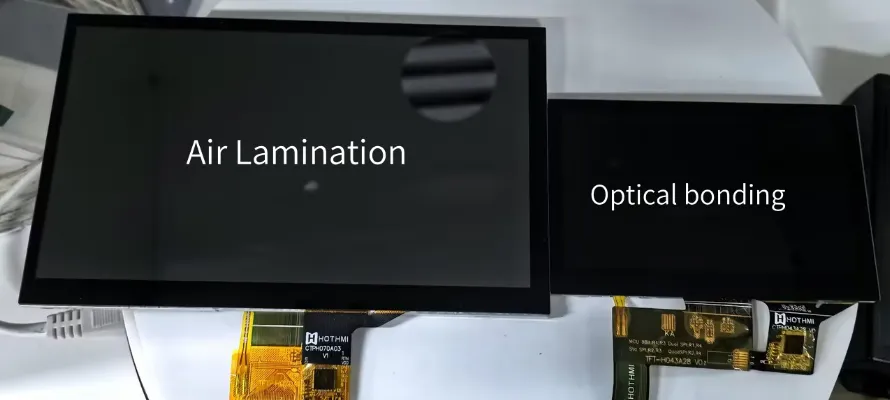
Optical Bonding lamination is an advanced screen module integration technology. Its core principle involves using highly transparent optical adhesives—primarily categorized into two types: OCA (Optical Clear Adhesive) tape and OCR (Optical Clear Resin) liquid adhesive—to completely fill the air gap between the display panel and the touch panel (or protective glass), thereby achieving a seamless bond. Specifically, this process utilizes precision coating or laminating techniques to ensure the optical adhesive is distributed uniformly between the two panels; upon curing, it forms a single, cohesive optical entity free of bubbles or impurities. This structure completely eliminates the air layer inherent in traditional bonding methods, effectively fusing the display panel, the optical adhesive, and the cover glass into a single refractive medium.
In terms of structural characteristics, a screen module produced via optical lamination exhibits exceptional structural integrity and optical consistency. Since the refractive index of the optical adhesive closely matches that of glass, it effectively eliminates light reflection losses at the interfaces between multiple layers, thereby significantly enhancing the panel's light transmittance and contrast ratio. Furthermore, the cured adhesive layer possesses both elasticity and strong adhesion; this dual nature allows it to provide cushioning protection for the display panel—enhancing the module's shock resistance—while simultaneously creating a fully sealed barrier that prevents the ingress of dust and moisture. Optical lamination is currently the mainstream method for bonding custom touch panels to display screens, and it is the technique that delivers the superior display performance for end-users.
Frame Lamination Process:
Frame lamination is a traditional and widely adopted method for screen assembly; it is frequently referred to as "border adhesive bonding" or "air bonding." The core operation involves utilizing double-sided adhesive strips (typically made of acrylic or foam materials) to bond and secure only the peripheral edges of the display panel to the touch panel (or protective glass). These adhesive strips are pre-die-cut into a rectangular frame shape; consequently, after the bonding process, physical connection is established solely within the border region, while the central viewing area of the panel remains hollow.
From a structural perspective, a screen module produced via frame lamination contains a distinct internal air gap. This means that after light is emitted from the display panel, it must sequentially traverse multiple interfaces between media with differing refractive indices—such as glass, an air layer, and a touch panel. Since the refractive index of air differs significantly from that of glass, a certain degree of reflection and scattering occurs each time the light crosses an interface. Although this structure physically integrates the various component layers, it does not constitute a continuous optical entity.
Advantages of full fit
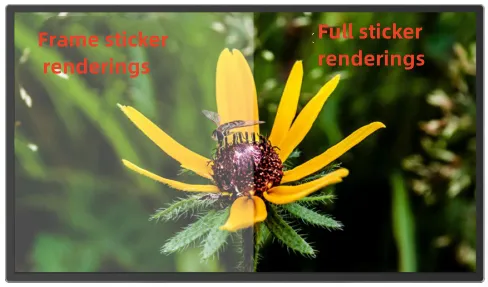
1. Reduce light reflection:Optical bonding eliminates the air layer between the display panel and the touch panel, thereby reducing light reflection, improving the brightness and contrast of the screen, and making the image clearer.
2. Improve touch sensitivity: Optical bonding closely combines the touch panel with the display panel, reducing the loss of touch signals and improving touch sensitivity and response speed.
3. Reduce the entry of dust and water vapor:Since there is no air layer, it is more difficult for dust and moisture to get inside the screen, improving the device's durability and water resistance.
4. Enhance mechanical strength: The optical bounding structure is stronger overall and can effectively improve the screen's impact and earthquake resistance.
5. The body is thinner and the frame is narrower: The optical bounding has a thinner body. The touch screen and display are bonded using optical glue, which only increases the thickness by 25μm-50μm; it is 7mm-10mm thinner than the frame.
6. Less noise interference: In addition to improving the strength of the touch screen and display panel, the full fit can effectively reduce the interference of noise on touch signals and improve the smoothness of touch operations.
Disadvantages of full lamination process: Complex process and high cost
Frame sticker technical features
1. Lower manufacturing cost: The process of frame bonding technology is relatively simple, and the cost of materials and equipment required is low, so the overall manufacturing cost is lower than that of full bonding.
2. Easy maintenance: Frame-mounted technology makes it relatively easy to disassemble and replace the display or touch panel during maintenance, reducing the difficulty and cost of maintenance.
Summary of differences:
Project | Optical bonding | Air Lamination |
optical effects | Low reflectivity and better display effect | There may be poor display effects caused by light reflection |
Touch performance | high sensitivity | Touch performance is slightly poor |
Durability | Optical bonding screens are better at dustproof, waterproof and shockproof | Slightly worse |
Cost and difficulty of manufacturing | High cost and complex process | Easy maintenance and low cost |
body shape | Thin body | Larger and thicker |
Noise immunity | smaller | Difference |
Click the video to see the difference between optical bonding displays and air bonding displays more intuitively: optiacl bonding displays vs. air bonding displays
Decision-Making & Guidelines:
Four Steps to Clarify Your Options
In addition to the comparisons outlined above, you can use the following four core questions to systematically identify the solution best suited to your needs:
Step 1: Assess Your "Optical Requirements"
Ask yourself: Will the device be used primarily indoors, outdoors, or under strong lighting conditions?
For outdoors: Optical bonding is highly recommended. It significantly reduces ambient light reflection—making it one of the most effective methods for improving screen visibility in sunlight—and often yields better results than simply increasing backlight brightness.
For indoors: Air bonding is typically sufficient and offers the best cost-effectiveness.
Step 2: Assess Your "Reliability Requirements"
Ask yourself: Will the device be exposed to severe vibration, extreme temperature fluctuations, high humidity, or dusty environments? (e.g., in-vehicle systems, heavy machinery, or marine equipment)
If the answer is “yes”: Optical bonding is mandatory. It fuses the cover glass and the display screen into a single unit, providing superior shock resistance and completely eliminating the risk of fogging or dust ingress within the air gap.
If the answer is “no”: If the device will be used in a clean, stable indoor environment, air bonding will fully meet your requirements.
Step 3: Assess Your "Maintenance Strategy"
Ask yourself: Is the device's maintenance strategy based on "replacing the entire assembly" or "performing quick on-site repairs/component replacements"?
If you prioritize “on-site repairs”: Air bonding is the more practical choice. Its cover glass, touch panel, and display screen can be separated and replaced relatively easily, resulting in lower repair costs.
If “replacing the entire assembly” is acceptable: You may opt for optical bonding to maximize performance and durability. However, be aware that if the internal layers of the screen are damaged, it typically means the entire module must be discarded.
Step 4: Consider Special Requirements
Do you require a narrow bezel, an ultra-slim profile, or support for wet-finger/glove touch input? Optical bonding is better equipped to support these advanced features.
Is the screen size particularly large (e.g., >10.1 inches) or does it feature a curved design? When choosing optical bonding for such cases, it is advisable to prioritize OCR (Liquid Optical Resin), as it provides superior gap-filling capabilities for large or uneven surfaces. For smaller screens, OCA (Optical Clear Adhesive film) is commonly used due to its more uniform thickness.



China Custom Industrial TFT LCD Display Manufacturer & Global LCD Supplier
Address:Building N3, Tian'an Digital Industry Park, Fenggang Town, Dongguan City, Guangdong Province, China